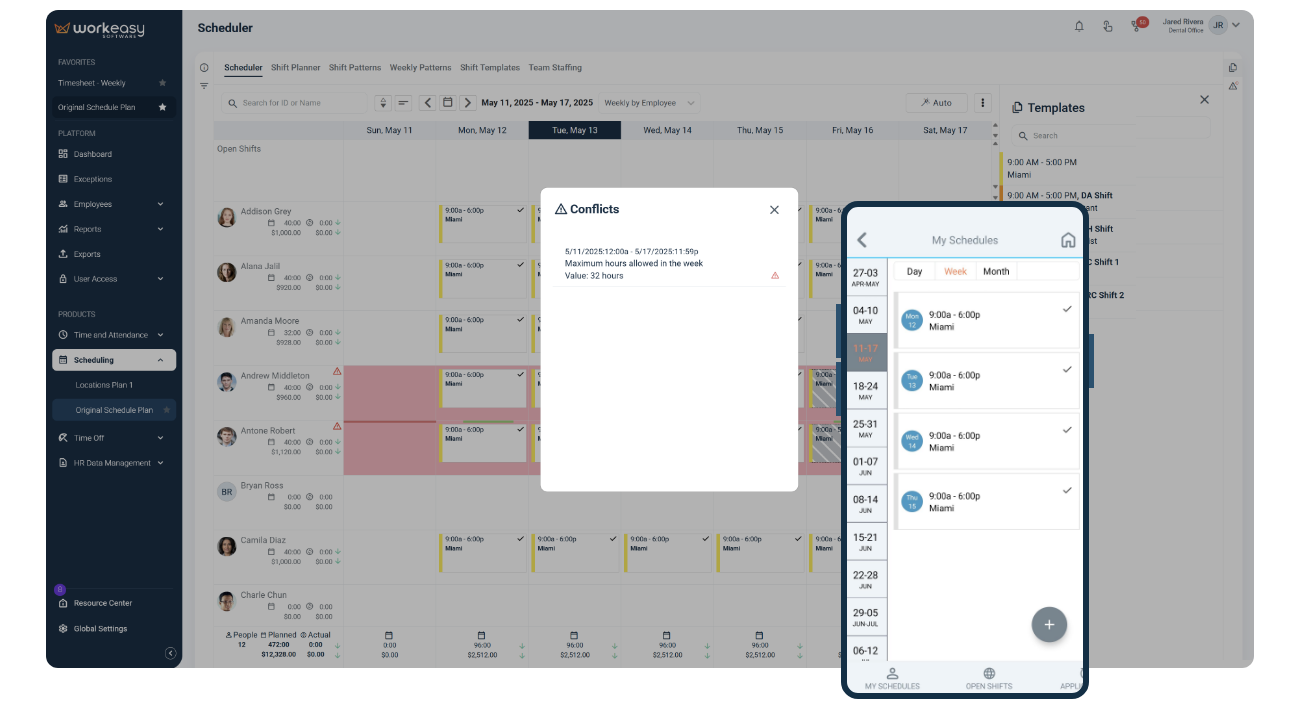
Managing shift schedules shouldn’t feel like solving a Rubik’s Cube blindfolded. Yet for many businesses, that’s precisely what it is: chaotic, exhausting, and risky.
The right employee scheduling software can bring clarity and control, saving you time, improving accuracy, and making your team a whole lot happier.
Whether you run a retail shop, a healthcare facility, or a national logistics operation, this question-and-answer guide will help you understand everything from what employee scheduling is all the way to how you should choose the best employee scheduling software for your business.
Let’s start with the basics: what employee scheduling software actually does and why it matters.

Scheduling software eliminates the chaos of manual processes and gives you a centralized, accurate, and accessible way to plan and adjust work.
Employee scheduling software is a digital solution that allows managers to create, manage, and communicate shift schedules, track time worked, manage absences, and adjust staffing levels as needed. It helps eliminate manual processes like spreadsheets and whiteboards, which are prone to scheduling errors and lack real-time updates.
This software streamlines operations by automating shift rotations, managing time-off requests, and instantly notifying employees of changes in shift assignments. It reduces no-shows, prevents overstaffing and understaffing, and improves department visibility. In short, it’s a foundational tool for optimizing workforce management and saving countless hours of admin time.
Modern scheduling tools also contribute to workplace transparency and accountability. Employees know when they're expected to work and can easily access their schedules from any device. A study by the Aberdeen Group on the benefits of employee scheduling software revealed that employees are six times more satisfied with their work when they can manage their own schedules in real-time.
Five key reasons you need employee scheduling software (and may not even know it):
Smart scheduling boosts more than productivity. It enhances team happiness, reduces burnout, and protects customer experience.
Deployed correctly, employee scheduling software significantly enhances business efficiency. Instead of spending hours juggling shift assignments, managers can create templates, use predictive scheduling tools, and apply rules to handle recurring patterns or compliance requirements.
Your business and teams get more accurate scheduling, increased employee satisfaction, and reduced administrative burden. With user-friendly software, employees can easily access their schedules remotely, swap shifts, and set availability, giving them greater control over their work-life balance, a key driver of retention and morale.
Another critical benefit is improved productivity. When the right people are scheduled at the right time, tasks get done more effectively, and customer service quality improves. Avoiding fatigue and overwork through smart scheduling also helps maintain high employee performance and well-being across the team.
Five top reasons employee scheduling software will help your business:
The most effective scheduling tools combine ease of use with deep functionality: automation, insights, and mobile-friendly design are table stakes.
The best scheduling software includes tools that cater to frontline workers and managers. Must-have features include:

Five top reasons employee scheduling software will help your business:
You’ll also want robust user permissions, role-based access, and the ability to create recurring schedule templates, especially for large or multi-location businesses. Just as important? Choosing user-friendly software that makes it easy for your team to build, view, and tweak schedules. No headaches, no steep learning curve.
Some advanced tools even include AI-driven suggestions for shift coverage or predictive scheduling based on historical data, employee preferences, and performance metrics. These intelligent systems help managers make faster, smarter decisions backed by real-time insights.
Tip: If a platform lacks five or more of these features, it may not meet your future needs.
Your software should scale seamlessly with your workforce, locations, and legal complexity without needing a major overhaul.
As your business evolves, your employee scheduling software must keep up with increased headcount, locations, and complexity without breaking your processes. A scalable solution supports thousands of employees, enables bulk schedule editing, and offers hierarchical access controls.
Also consider the platform’s ability to support labor law compliance across regions, including shift differentials or collective bargaining agreements. This ensures your scheduling practices can adapt as your operations expand across cities or states.
Make sure your chosen platform doesn’t lock you into rigid workflows. Look for customizable modules and API access that allow you to evolve your scheduling strategy as your team structure and priorities change.
Your employee scheduling software will grow with you if it:
Scheduling doesn’t happen in isolation. Your platform should connect effortlessly to HR systems, payroll, and comms tools.
In today’s tech ecosystem, no tool should exist in a vacuum. Effective scheduling software should integrate easily with:
Integrations eliminate data silos, reduce manual entry, and create a unified view of your workforce. This is especially important in industries like healthcare or retail, where staffing mistakes can lead to compliance violations or lost revenue.
By syncing with your HR systems, employee scheduling software also helps during onboarding, automatically assigning shifts to new hires based on their availability, location, and training status.
Integration-ready employee scheduling software:
One size doesn’t fit all. The best choice fits your industry, team structure, and frontline realities.
There’s no one-size-fits-all solution. It’s essential to consider your business’s unique structure. For example, here’s how three industries might look differently at what they need from employee scheduling software:
No matter your industry, great employee scheduling software should support your broader workforce management goals, helping you work more efficiently and keep your team engaged.
Talk to your teams, especially frontline supervisors, about their most significant pain points. Then test platforms that directly address those issues. Involve key stakeholders in trials and demos, and evaluate tools based on functionality, ease of use, software support, and ROI. And, when things go wrong, having responsive software support can save you from hours of headaches and missed schedules.
Also, assess whether the vendor offers adequate training resources and how responsive they are to support requests.
At a glance, consider these features based on your needs:
Costs vary, but value compounds fast, especially when weighed against time, errors, and risk.
When budgeting, consider both the upfront and ongoing costs. Some platforms charge per user per month, while others offer tiered pricing based on features or employee count. Beyond licensing, watch for:
Also, factor in the cost of not upgrading: time lost to manual scheduling, payroll errors, or compliance fines. When done right, the investment in employee scheduling software pays for itself quickly through increased business efficiency.
Some vendors also offer ROI calculators on their websites, which can help you estimate potential savings based on your current scheduling inefficiencies. Consider using these tools as part of your evaluation process.
Keep in mind these five cost factors:
From last-minute gaps to compliance missteps, good software proactively manages risks before they become problems.
Businesses face a range of scheduling challenges: last-minute changes, employee availability conflicts, managing part-time staff, or meeting legal requirements. These issues lead to disengagement, confusion, and even legal trouble.
The right software solves these problems by:
Employee scheduling software ensures your workforce is aligned with business needs in real time, increasing flexibility and accountability.
It also prevents burnout by helping managers balance workloads and avoid scheduling the same employees for back-to-back shifts, which is both an employee satisfaction and labor law compliance issue.
At the least, today’s employee scheduling software should:
Adoption matters. A good tool only delivers value when teams use it fully and consistently.
Getting the most from your employee scheduling platform means more than just logging in. You’ll need to encourage adoption by training your team, customizing workflows, and regularly reviewing your scheduling and attendance management data.
Use reporting and analytics to evaluate labor costs, monitor absenteeism, and identify high-performing employees. Set up alerts for compliance risks, overtime thresholds, and shift conflicts. And keep an eye out for new features or integrations that could enhance your system over time.
Periodic reviews of your scheduling practices help ensure you’re meeting organizational goals while maintaining fairness and flexibility for employees.
Five tips for getting the most from your employee scheduling software:
Choosing smarter goes beyond checklists of features. You want a solution that fits your reality and helps you lead with confidence. A smart platform saves you time, protects your people, and fuels business momentum.
Managing a workforce is about a lot more than filling shifts. It’s about making every schedule decision count. The right employee scheduling software doesn’t just organize your team. It elevates your entire operation. So, take the time to assess your needs, involve your team, and find a platform that truly works for your people. Better scheduling means better business and a better experience for everyone.
If you're ready to put all these insights into action, WorkEasy Scheduling was built with leaders like you in mind. Designed to simplify your process from end to end, WorkEasy Scheduling helps you create, publish, review, and analyze schedules with unmatched flexibility and ease. You spend less time jumping through hoops and more time working on what matters most.
At the end of the day, you want the right employee scheduling software because:
Let WorkEasy Software show you how effortless, powerful, and game-changing smarter scheduling can be.
Ready to schedule smarter?